Oskar Chmioła / Works and actions
Au(c)tor. Diagrammatic Scheme
Au(c)tor. Schemat diagramatyczny
Below are the complete assigned source sections, with images, films, links and credits. Each section also links to the entire document. Translations are drafts; unverified details have not been filled in.
Navigation categories based on the cited sources; they do not assign an artistic movement. Medium, technique and role require separate descriptions.
A colour print on A0 paper from 2023, presented as “Bodily Topology of Creativity – Topomorphy of Auctor / Opus Map”. The diagram depicts one spiral cycle of indywiduAkcja and arranges the psychosociological conditions of artistic creation in a matrix resembling a human body. The source connects the artist’s term indywiduAkcja with C.G. Jung’s concept, emphasizing the artist’s active role. The complete description and illustration are retained.
- Year in the source
- Oskar Chmioła’s role
- text authorship
- Medium / form
- diagram
- Technique and material
- colour print on paper
- Format / dimensions
- A0
Full texts and documentation
Captions and credits remain in their source context. Group exhibition documentation is not automatically documentation solely of Oskar Chmioła’s works.
visual arts
Separate source record · chmiola.com
1. “Au(c)tor. A Diagrammatic Schema”, 2023, colour print on A0 paper.
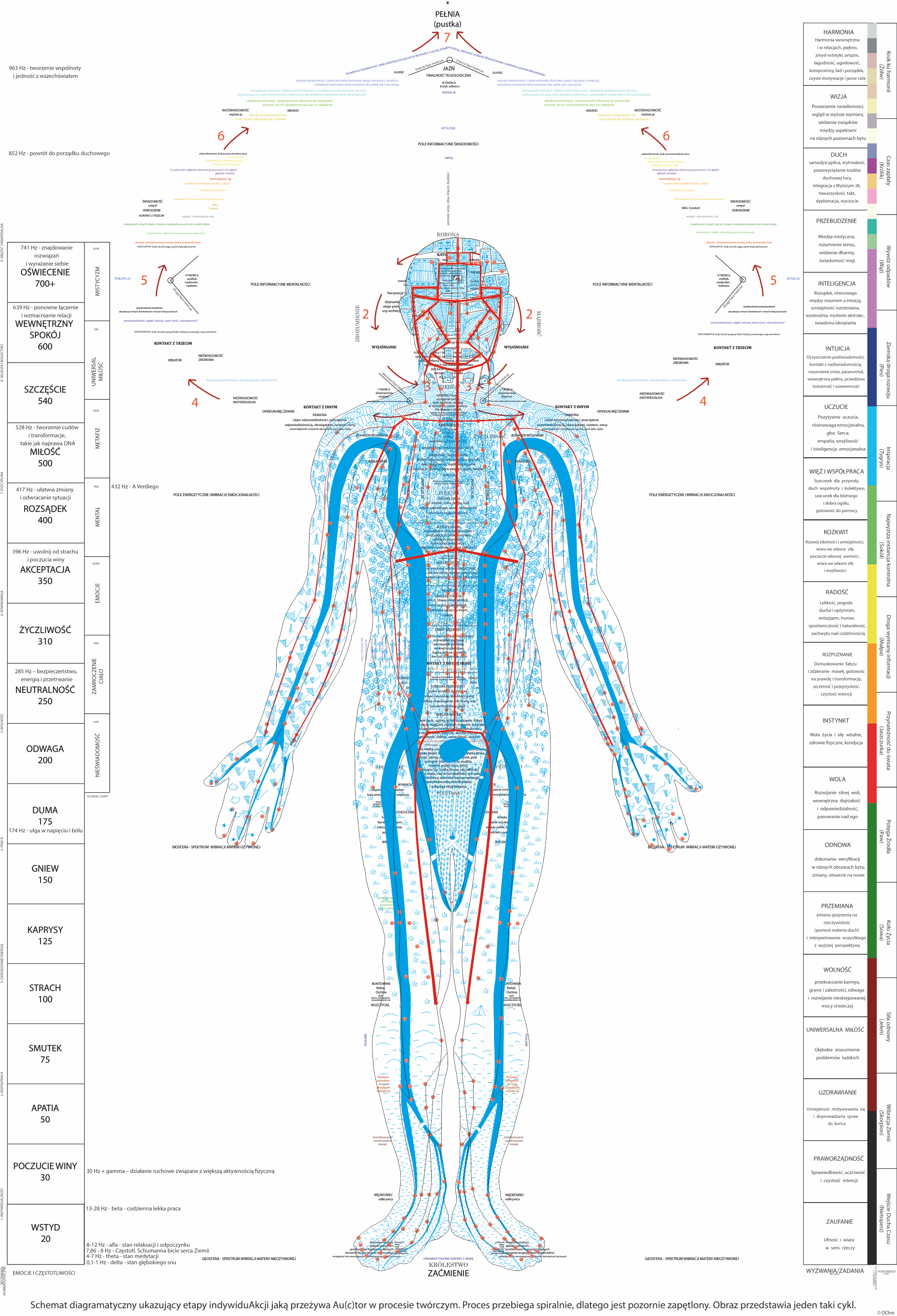
Diagrammatic schema: The Bodily Topology of Creativity — Auctor’s Topomorphy / Opus Map.
The schema shows the stages of IndywiduAkcja experienced by Auctor in the creative process. The process proceeds in a spiral, which makes it appear looped. The image depicts one such cycle. IndywiduAkcja is a conscious reference to C. G. Jung’s concept and an emphasis on the active nature of this process. The diagram is an attempt to visually assemble and systematize human entanglement in a psychosociological configuration of forces, whose various forms and dimensions create a matrix resembling the human body. Every human being, and therefore every artist, lives in this realm of Opus, full of colliding influences from different philosophies, religions, science, art, psychology and sociology. The artist is therefore an Auktor (from the Latin auctor — agent, creator, first, authority, “one who does”, “who strengthens”, “brings about action”…) — an active agent.
Editorial status
Harmonising dates, techniques and roles, and comparing with current sources, remain subject to verification.