Oskar Chmioła / Realised / 2014
SpaceTime Performance — meeting in Lublin
SpaceTime Performance is a project developed by Oskar Chmioła since 2013. The documented meeting in Park Saski in Lublin took place in 2014. STP is a format for jointly shaping situations in time and space: a participant can move from observation to their own intentional expression. The preserved texts connect the development of this idea with the earlier Przestrzeń Performance.
Key facts and classification
- Date / period
- 2014
- Place
- Park Saski, Lublin
- Role and collaborators
- initiator of the format and the meeting
- Genre
- performance meeting; artistic initiative
- Type of event
- collective meeting
- Approach / perspective
- participatory and process-based practice
- Movement / milieu
- SpaceTime Performance — a movement initiated by Oskar Chmioła
- Thematic strand (interpretation)
- Participation and co-creation; Speech as action
- Style / mode of realisation
- multiple authorship, situational
The classification is an editorial interpretation. Comparative categories do not imply membership of a movement or a declared source of inspiration.
Description of the work and the artist’s account
Preserved account: STP — translation of the Polish text
Full document in the archive · Source URL
STP is a social movement whose principal premise is that reality is performative and is transformed by performers, while life in such a reality is composition in time and space — morality is estEtyka.
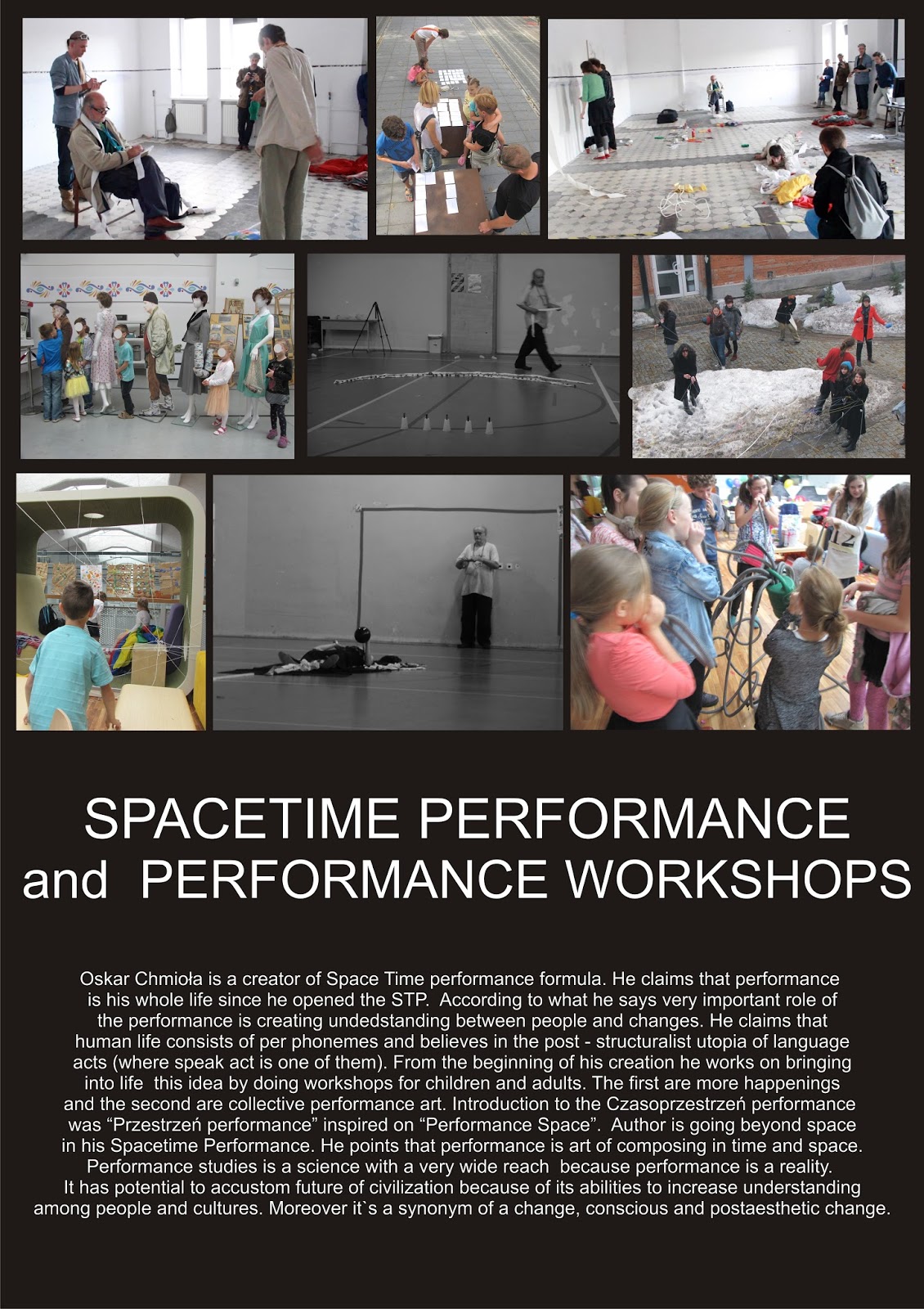
Oskar Chmioła, as the creator of this SpaceTime Performance format, states that performance art is his entire life. According to him, a very important role of performance art is to create human relationships and change. He states that human life consists of perfonems and believes in the poststructuralist utopia of performative communication (of which speech is one form). From the beginning of his practice he has worked to put this idea into effect through workshops for children and adults. The introduction to Spacetime was Przestrzeń performance, inspired by Performance Space. The artist moves beyond space in his Spacetime Edition. He points out that performance is the art of composing in time and space.
Performance studies is a field with a very broad scope, because performance is reality. It has the potential to create the future of civilisation through its capacity to increase understanding among people and cultures. It is also synonymous with change, conscious change, and an aesthetic form.
The SpaceTime Performance format means that each participant becomes its creator. This makes STP a social movement of cosmic reach.
© Oskar Chmioła
Context of the practice: Performance Spacetime
Full document in the archive · Source URL
The document describes the broader practice. It does not confirm the detailed course of this event.
Additional account supplied by the artist, September 2026
SpaceTime Performance is a project developed by Oskar Chmioła since 2013. The documented meeting in Park Saski in Lublin took place in 2014. STP is a format for jointly shaping situations in time and space: a participant can move from observation to their own intentional expression. The preserved texts connect the development of this idea with the earlier Przestrzeń Performance.
An open score and the development of STP principles
The notes archive distinguishes successive formulations of SpaceTime Performance’s principles. ‘25 Points of Performance Spacetime, or the Structure of POMOST’ is recorded as a note created on 26 October 2013. ‘26 Points of Performance Spacetime, or the Structure of STP Meetings’ is internally identified as the fifth version, dated 1 August 2020. These are neither two independent projects nor two descriptions of the same meeting, but evidence of the format’s development. The export also contains later modification timestamps, so a note’s creation date does not establish when every sentence in its preserved version was written.
The 25-point version distinguishes a meeting’s external form—individual presentations and collective actions—from its inner dimension: conscious fellow-feeling and work with a participant’s concrete experience. The later 26-point version addresses the variability of time, place and modes of documentation more extensively. It sets no single mandatory duration, instead describing a format shaped by initiators and participants in particular circumstances. The expanded point on a ‘concrete life issue’ permits a personal problem, desire or question to be encoded in an object or action. Disclosure need not therefore take the form of direct confession: what matters is opening a way for others to read it.
‘An Example of a Situational Plan for an STP Meeting’ translates this principle into spatial organisation. Objects distributed around the area of action form a movable boundary and a repertoire of expressive means. The initiating person can use them, introduce their own objects or act solely through the body. The next participant responds to the situation left by the previous one or joins while their action is still in progress. The response may be a dialogue, commentary, parody or another relationship between actions. Moving the objects changes both the visual composition and the boundary of the situation itself. This is an open relational score rather than a script prescribing a sequence of behaviour. The two preserved variants of the plan reveal revisions to the same proposal; they should not be counted as separate performances.
The note ‘Concretisation of Behaviour’ distinguishes ways of working: improvisation as spontaneous action, verification as an action thought through but not rehearsed, and composition as the presentation of an act shaped in advance. It separately considers one-off, repeated and processual actions enriched by earlier performances. This distinction makes it possible to describe STP without equating the entire practice with improvisation. The artist refers to Richard Schechner’s Performance Studies in this note, and to Grotowski, Artaud, Fluxus, Dada and Akademia Ruchu in the situational plan’s introduction. These are references he explicitly declares, not similarities attributed from outside.
These documents expand knowledge of a method developed since 2013, but a later score is not automatically an account of its use in Park Saski in 2014. Analogies with mystery rites, paratheatre and therapy belong to the project’s artistic vocabulary; they do not themselves confirm clinical efficacy or the provision of healthcare. The account of the Lublin meeting therefore distinguishes the confirmed event from STP’s broader, evolving programmatic framework.
Source: the artist’s Facebook notes archive, records 6, 4, 1, 2 and 3; editorial account based on the preserved versions.
Interpretation of the project
SpaceTime Performance is the artist’s format for collective action and communication without dialogue. Acting together requires neither an identical script nor a uniform language. The notion of the speech act, invoked in the portfolio, makes it possible to read gestures as actions that create relationships. This is an editorial interpretation. The start of the project’s development in 2013, confirmed by the artist, should be distinguished from the 2014 meeting in Park Saski in Lublin recorded in the historical list.
Images, files and documentation
Original portfolio boards
Links preserved in the documents
Art-historical and humanities contexts
Suggested readings and comparisons, distinguished from documented references.
Participation and co-creation
Roman Ondák, Lygia Clark
Speech as action
John L. Austin, Roman Ondák
CV entry supplied by the artist — translation
2014 — opened the SpaceTime Performance movement and held its first meeting, Park Saski, Lublin,
Editorial account updated on 28 September 2026.